Cinematic Canvas Update
🎬 The Invisible Infrastructure That Makes Creative Tools Feel Magical
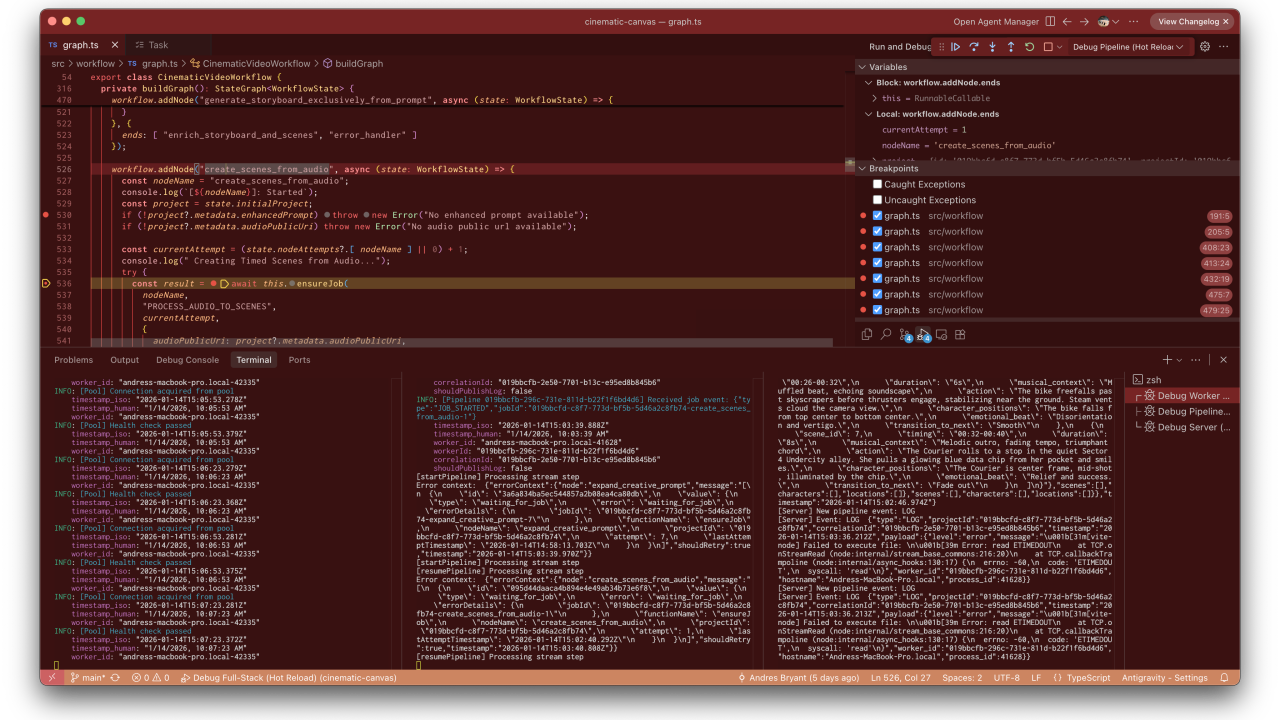
The best creative tools feel effortless because someone spent weeks making the invisible parts bulletproof. This week, I enhanced the Cinematic Canvas infrastructure to make the user experience feel like magic. Underneath the hood: distributed services efficiently transmitting data across unreliable networks.
Here is the technical breakdown of how the product has transformed from an API call into a fault-tolerant framework for generative filmmaking.
1. Achieving Exactly-Once Execution in Distributed Workflows
Generative filmmaking is an expensive, multi-stage process. If a network jitters or a browser refreshes, a naive system risks double-spend on compute or, worse, data loss. A user might double-click “Generate,” or a server might crash after processing a job but before acknowledging it.
To prevent duplicate renders and wasted compute, I implemented a strict chain of idempotency safeguards and atomic message tracking.
- Atomic State Transitions: We track message lifecycle using a “claim-and-verify” pattern. When a worker process claims a job, it executes an atomic transaction. If a duplicate message arrives due to a retry, the system detects the existing claim and acknowledges the message without redundant processing.
- Optimistic Concurrent Control: The solution implements Optimistic Concurrent Control at the database layer. When a worker claims a message, it performs an atomic update with an attempt counter. If a duplicate message arrives, the system detects the existing claim and acknowledges the message without reprocessing.
- Ack/Nack Strategy: Acknowledging a message too early risks data loss if the process crashes; acknowledging too late promotes duplicates. We now use Instance Subscriptions that auto-expire. If a handler crashes mid-execution, we issue a “negative acknowledgment” (nack), allowing the queue to trigger an automatic retry on a healthy node.
The Benefit: Users get a “set it and forget it” experience. You can start a render, lose your internet connection, or refresh the page, and the system guarantees your work will neither duplicate nor vanish.
Reliability at the message layer is only half the battle. Once a job is successfully claimed, the system must survive the “long-tail” of generative processing—where tasks can span minutes across multiple AI models.
2. Autonomous Lifecycle Management and Fault Tolerance
Creative workflows are long-running. A 60-second video might take 12 minutes to generate. During this window, spot instances can evaporate and pods can restart. Rather than reactively recover from failures, I built a JobLifecycleMonitor that treats instability as a constant and handles failure modes with precision.
- Failure Mode Differentiation: Not all errors are equal. Our monitor now distinguishes between
RETRYABLE(Failed) andFATAL(Permanent) errors. A network timeout triggers an exponential backoff; a malformed prompt triggers an immediate halt to save compute costs. - Self-Repairing Loops: Stale jobs—those running longer than their TTL—are automatically requeued. This ensures that even if an entire availability zone goes dark, the work eventually finds a path to completion.
To make this debuggable in production, I implemented Distributed Context Propagation using AsyncLocalStorage. Every request is tagged with a structured context—jobId, traceId, and workerId—that flows from the API gateway through the message queue to the final database write.
The Benefit: For the user, this means “Resume-ability.” If a worker node restarts mid-render, another picks up the baton automatically. The user never even knows there was a ripple in the infrastructure.
For the engineering team, this turns a grep session into a two-minute search. We no longer guess why a generation hung at 73%; we see the exact state transition and root cause immediately.
The Meta-Point: Reliability is a Product Feature
In the AI space, many tools are just impressive demos that shatter under real-world conditions. By building these guarantees—Exactly-Once delivery, Optimistic Concurrency, and Distributed Context Propagation—I’ve cleared the path for the next phase of the Canvas.
This infrastructure unblocks:
- Generative Cinema in a Creative Framework: We’ve moved from “one-off” generations to a structured system where AI is a dependable component of a larger creative engine.
- Stateful Pipeline Orchestration: We can now track complex, multi-model dependencies across distributed nodes without losing the “thread” of the creative intent.
- Horizontal Scalability: By decoupling the API from the worker via an idempotent queue, we can scale compute infinitely to meet demand without increasing the risk of race conditions or data loss.
The goal is a generative tool that professionals trust. Because the future of cinema is generative, but only for the companies that make the “impossible” feel effortless.
🔗 Explore the code here: github.com/digitalcreationsco/cinematic-canvas